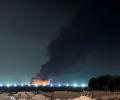
The IRGC said the barrage targeted several US military facilities in the region, including bases at Sheikh Isa in Bahrain, Juffair in Bahrain, Ali al-Salem in Kuwait and Al Azraq in Jordan.

Iran is set to witness more brutality as the administration has decided to execute its first protester on Wednesday amid mass arrests of anti-regime protesters, New York Post reported, citing human rights groups.

Pakistan's Prime Minister Shehbaz Sharif has engaged in extensive diplomatic efforts to de-escalate the conflict in West Asia, offering to host talks between the US and Iran and engaging with leaders from Saudi Arabia, Qatar, Malaysia, the UK, China, and the European Union.

Two Indian ships carrying liquified petroleum gas (LPG) from the Gulf countries crossed the Strait of Hormuz early on Saturday morning, raising the number of Indian vessels safely passing through the war-hit, narrow shipping lane to three.

'TTP has vowed to take revenge for the attacks that Pakistan is carrying out against Afghanistan.' 'To diminish this threat, Pakistan is hitting Afghanistan hard.'

Taking Kharg would give the US control over virtually all of Iran's oil exports and thus provide significant leverage, notes Prem Panicker in his must read daily blog on the Gulf War. It would also put American troops within range of Iran's remaining missiles, drones, and artillery on a piece of real estate that is just eight square miles in size, and just 15 miles from the Iranian mainland.

The Indian embassy in Tehran has earlier stated that it is facilitating the safe movement of nationals who wish to leave Iran.

Israeli Prime Minister Benjamin Netanyahu has threatened to continue targeting Iranian leaders, claiming recent successes in eliminating key figures. He asserted that Israel, with US support, aims to undermine the Iranian regime and empower the Iranian people.

Trump may strike. He may announce productive talks and extend again. He may do both at the same time. Iran will not open the Strait on someone else's terms, so no matter what happens, that problem will remain unsolved. And the IRGC will still be collecting its $2 million toll from every ship bold enough to ask permission to pass.

'The next two to three weeks will not be decided in Washington.' 'They will be decided in Tehran, in whatever calculation Iran makes about the costs of continued resistance against the costs of appearing to have yielded.'

Eighteen months of preparation hang in the balance at a Tucson-based multi-use sports facility, where organisers say they remain in daily contact with FIFA about hosting Iran's national soccer team, even as geopolitical turmoil threatens to upend their World Cup plans.

Anti-government protests in Iran have continued for the fourteenth consecutive day on Saturday, with authorities tightening security measures as demonstrations spread across multiple cities.

The delegations from the US and Iran head to Islamabad on Friday, carrying a ceasefire that is already fraying, a Strait that is technically open and practically closed, and a negotiating agenda that would challenge even parties actually negotiating in good faith, which these groups are not. Prem Panicker continues his must read blog on the Iran War.
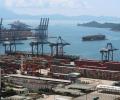
With the Iran war escalating sharply and crisis deepening in the global energy market, India on Monday unveiled a coordinated plan to support exporters and shippers caught in the fallout.

When missiles fly in this region, they are never just aimed at military targets.

By all available indications, the White House drafted a face-saving note and handed it, ready-made, to Islamabad. Pakistani Prime Minister Shehbaz Sharif was supposed to then post it in the guise of a plea urging Trump to extend the deadline by two weeks 'to allow diplomacy to run its course'. Trump would then graciously accept Pakistan's 'request' and declare a ceasefire. Sharif dutifully posted the message on X. Except that he, or whoever was handling the account, forgot to delete the tell-tale first line visible in the edit history: 'Draft - Pakistan's PM Message on X'. Prem Panicker's must read blog on the Iran War.

The core issues to be settled -- access to Hormuz, Israel's aggression in Lebanon, the question of Iran's nuclear programme, sanctions relief and compensation -- are thorny enough to require weeks of patient negotiation. The most likely outcome of the opening sessions is that both sides take the measure of each other, establish what is and is not negotiable, and return home without having broken anything. That would count as progress.

Egypt, Pakistan, Saudi Arabia and Turkey met in Islamabad in what analysts say is the formal opening of a new diplomatic formation that could reshape the post-war regional order. Their immediate goal is a ceasefire; their larger ambition is to ensure that neither Iran nor Israel emerges from this war in a dominant position. Pakistan's foreign minister then flew directly to Beijing and mooted a Chinese role as guarantor of any eventual agreement. Prem Panicker continues his must read daily blog on the Gulf War.

The LPG squeeze on India's restaurant sector is the quotidian face of a deeper crisis.

'I suspect that Bangladesh being given permission stuck in India's official craw, and this story was an attempt to balance the scales by giving the impression that a similar waiver had been given to India as well.'

Will rising tensions between US-Israel and Iran threaten crude oil supply through the Strait of Hormuz, putting India's fuel prices, imports, and economic stability at risk?

The question is no longer whether the war will expand. It has. The next few days will tell us whether the war stabilises around Hormuz or whether the Strait itself becomes the trigger for a far larger rupture. What to watch for over the next 48 hours is simple: Any move by the US toward direct naval control of the Strait; any credible Iranian attempt to disrupt or mine shipping lanes and, critically, whether energy infrastructure in the Gulf continues to be targeted.If those lines are crossed in tandem, the war will no longer be containable within the region.

Iran is fighting a different war: Older, slower, and in some ways more dangerous. Iran doesn't need to shoot down an F/A-18. It only needs to make the Strait of Hormuz feel dangerous long enough for insurance markets, shipping companies, and oil futures traders to do the rest. Prem Panicker continues his must-read daily blog on the war in the Middle East.
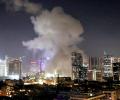
Israel's ongoing airstrikes and Iran's retaliation raised concerns about all-out war between the countries and propelled the region, already on edge, into even greater upheaval.

What we are watching is something different: A fog manufactured and maintained by the people who started the war, so that the question of why it was started never has to be answered, observes Prem Panicker in his must read blog on the war in the Middle East.

The IRGC said that Ismail Haniyeh and one of his bodyguards were killed after their residence was targeted in Tehran.

Fight on toward goals that keep receding, or exit with most objectives unmet. Trump is agitated, his poll numbers falling below the Plimsoll line, his base fractured between those who back the war and those who remember that he campaigned on ending them.

Khamenei, who has the last word on all state matters and is also the commander in chief of the armed forces, instructed military commanders from the Revolutionary Guards and the army to prepare plans for both an attack and a defence in case the war expands and Israel or the US strike Iran, the officials said.

The statement by IRGC which was televised on the country's state media, came, three days after Haniyeh was killed at his accommodation in northern Tehran following his attendance at the inaugural ceremony of Iran's new president Masoud Pezeshkian.
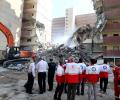
The IDF said that all of its bases, including air bases, are operating as usual with no harm to their functionality.
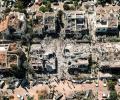
Trump has a major decision to take in coming days -- specifically, how to rescue Israel from the attritional war that lies ahead, points out Ambassador M K Bhadrakumar.
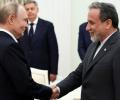
Will Russia's entry deter Trump on his warpath?, asks Ambassador M K Bhadrakumar.
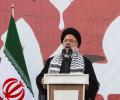
Nine people were on the helicopter that crashed in northwest Iran on Sunday, including three officials, an imam, and flight and security team members, as reported by Tasnim news.

General Soleimani headed the Islamic Revolutionary Guard Corps's Quds Force and also served as Iran's pointman on Iraq.

As per the Israeli Air Force, the fighter jets attacked a number of terrorist targets of the terrorist organization Hamas throughout the Gaza Strip. Among other things, the planes attacked a military compound and a weapons warehouse.
The direction comes hours after Iran fired over a dozen ballistic missiles targeting at least two American bases in response to the killing of its General Qasem Soleimani in a drone strike.

United States President Donald Trump has warned Iran of "major retaliation" if Tehran carries out any attack against America to avenge the killing of top military commander Qasem Soleimani and hinted at striking its cultural sites. His statement came hours after Iran announced it will no longer abide by the limits contained in the 2015 landmark nuclear deal.

The President, in a tweet, said that the 52 sites include some 'very important to Iran and Iranian culture'. The tension between US and Iran has escalated since the killing of powerful General of pro-Iran militia in Iraq.

Iranian state television on Wednesday claimed that at least 80 "American terrorists" were killed after Teheran launched 15 missiles on US targets in Iraq.

The United States and Iran severed formal relations in 1980 after the Revolution and ties were hostile when their soccer teams clashed in the 1998 World Cup.
